



Hi, I'm Jen! I'm a personal finance expert and money coach aiming to help you take control of your money. I went from being broke to a six-figure net worth and am now on track to be financially independent at age 40. Discover Jen's story
How much savings by age should you have? Even though savings are essential, nobody tells you how much you need. Even in schools, this topic is hardly ever touched upon.
Personally, I have always been the person to have an equal amount of savings, irrespective of my age. Largely because retirement always seemed so far away (and it still is).
There are so many needs in the present, and there is still so much time in the future. Yet, when asked, people will almost always reply that the best day to start saving was yesterday.
Average Savings by Age in the UK
There is a big savings gap in the UK.
The majority of young adults (53%) have no savings at all. And the lack of savings is not only a problem for young people. Only 67% of people aged 35-44 years have more than £100 in their savings account.
According to Money Statistics, 9.79 million households within the UK are without savings.
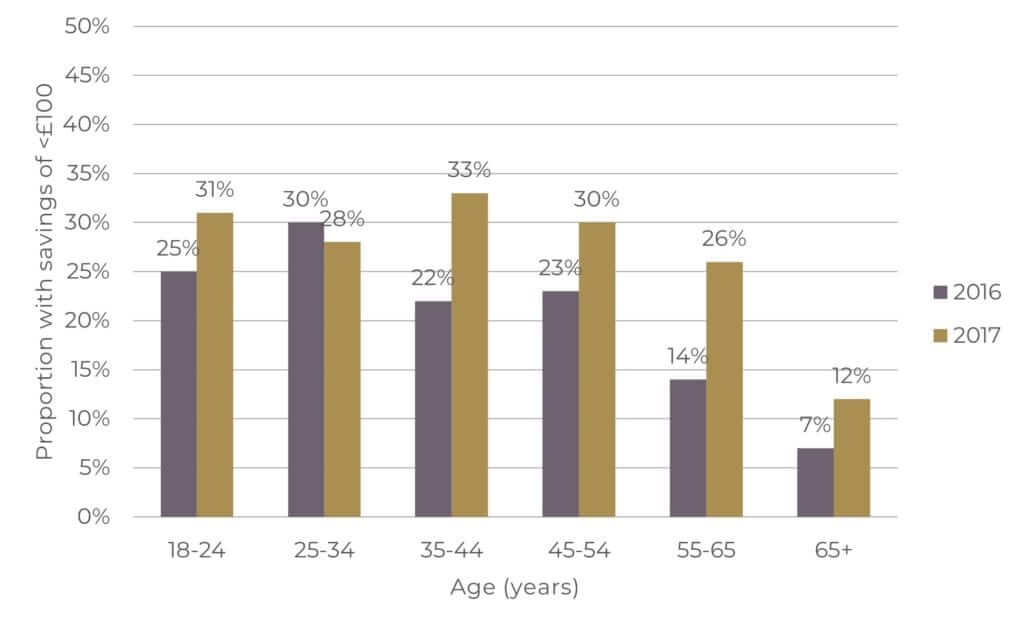
How much does the average person have in their savings account? Data for average savings by age in the UK for 2017 show that many people in the UK are only one crisis away from being a regular at the foodbank (source Statista):
- Age 18-24: £8,000
- Age 25-34: £11,000
- Age 35-44: £16,000
- Age 45-54: £26,000
- Age 55-64: £37,000
- Age 65-74: £49,000
- Age 75+: £38,000

How Much Savings by Age Should You Have?
“Savings” is a very general term and to understand how much savings by age you need, we have to break it down a little. There are three types of savings you should have:
- Emergency fund
- General savings
- Pension
1. Emergency Fund
Savings in your emergency fund (money reserved for emergencies) are not age dependent. However, they are a must-have before you even think about retirement or anything else.
As for your emergency fund, you should have three to six times your monthly expenses saved up. The exact amount depends on your preference and your individual situation.
For example, if you are self-employed, or have no family you can rely on, you may want to save more than six times your monthly expenses.
Monthly Expenses x 3-6 = Savings for Emergencies
“Expenses” means how much you need to spend a month to survive (while eating every day and not sleeping under a bridge).
These expenses include rent, bills, mortgage payments, food, essential travel costs, and everything else that you have a responsibility to pay.
The average expenses in the UK per month are £2,249 per month for a single person and £3,803 per month for a family of four.
So assuming a multiplier of four, the average person should have an emergency fund of £8,996 if they are single or £15,212 if they have a family.
2. General Savings
The amount of general savings really depends on you! Do you want to go on a fancy holiday every year? Do you want to buy a new car or a shiny TV?
Many people also save for important life events such as their weddings. If that does not appeal to you, you may at least want to save up for Christmas to buy presents.
If you do not have any savings goals, you can still save some money for future things you may want to buy. There are no general recommendations on how much this should be so you are totally flexible.
3. Retirement Savings
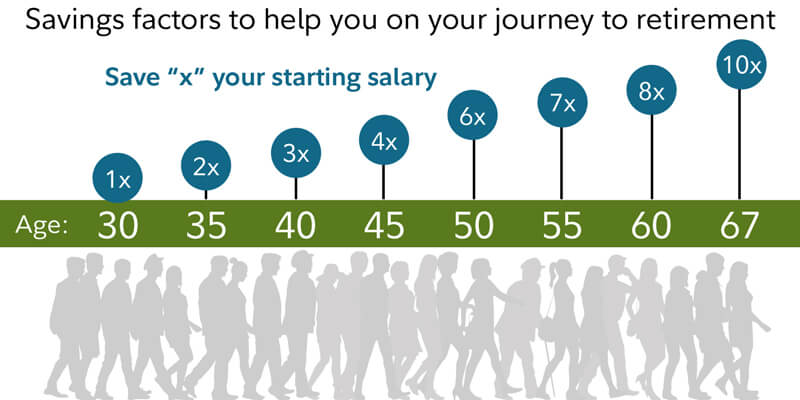
Fidelity, an American financial services corporation, recommends looking at your salary to determine the amount of savings you should have for retirement.
At age 67, you should have 10 times your pre-retirement income saved for retirement. This means when earning £35,000 a year, there should be £350,000 in your retirement pot.
To reach this goal, Fidelity offers a guideline of how much savings by age you should have:
When my company invited a pension advisor to give free pension advice to employees, my first question was how much money I need in my pension pot.
Their answer was to put away as much as they can without stating a number at all. Their answers on how much savings by age someone should have was not much more specific either.
And that is sadly pretty typical British pension advice.
Examples
1. How Much Savings Should I Have at Age 30 in the UK?
Let us assume you are 30 years old, earn £30,000 per year and have £1,500 expenses every month.
Looking at the savings by age recommendations above, you should have £4,500 to £9,000 in your emergency fund and £30,000 in your pension pot.
This means your minimum savings should be at least £34,500.
If you have savings goals, plan to make any big purchases, or save for a house deposit, you need more savings.
2. How Much Savings Should I Have at Age 35 in the UK?
So now you turned 35. If you still have a salary of £30,000 and expenses of £1,500 per month, your savings should have changed quite a bit.
Your emergency fund should still be between £4,500 and £9,000. However, you should have £60,000 in your pension now.
Thus, your total savings at age 35 in the UK should be around £67,000.
3. How Much Savings Should I Have at Age 40 in the UK?
Fast forward ten years and you are now 40 years old. How much money should you have now?
Based on the savings by age recommendations above, your emergency fund will stay the same, assuming your expenses have not changed.
Thus, you should still have £4,500 to £9,000 in your emergency fund.
However, your pension pot should have grown in the past ten years. You should now have a whopping £90,000 in there (3 x £30,000).
Even if your salary has changed, you still use £30,000 as the basis for your calculation.
Therefore, you should have a minimum of at least £94,500 in your pension.
4. How Much Savings Should I have at Age 50 in the UK?
At age 50, retirement is already approaching. Thus, you should have at least £180,000 in your pension (based on a starting salary of £30,000).
Your emergency fund should still be a multiple of your expenses. If these have not changed, you should have total savings of around £190,000.
As you become older, you also experience health issues. Thus, if you can you should increase the size of your emergency fund.
Note that the amount you should have in your pension increases quite steeply. Assuming zero interest or growth on your pension, you would need to contribute £500 every month to reach the target amount at each milestone up to age 45. Because your pension is invested (hopefully), you need to contribute less (very roughly around £350).
What to Do if You Do Not Have Enough Savings
Fidelity provides clear milestones that help you achieve your retirement goals. Easy on paper but hard to turn into reality.
People often have other expenses that prevent them from saving for retirement e.g. university fees, weddings, and children.
If you currently have less in your pension than you should, it may be time to increase your contributions. Depending on your situation, you may want to look into 100 ways to make money or reduce your expenses.
There is no reason to get depressed if you are nowhere near the required sum. Just try your best to catch up while still leaving enough money to enjoy your life.
Limitation of This Savings by Age Recommendation
Fidelity’s retirement savings by age recommendation is a model and as such, should be used carefully. Your salary may increase over time (which is good), but can also decrease.
For example, you could take time off work to care for children or due to illness. Or you could discover that you want to work in a lower-paying but more fulfilling job.
Life is not as predictable as the savings by age model so I recommend saving more than 25% in good periods to be prepared for the bad times to reach your recommended savings by age.
For some, having to save “only” 25% of their annual income may be an excuse to waste money once they have fulfilled their savings quota.
This will mean these people will remain trapped in the rat race and have to work until they are aged 65, when in fact, they could have reached financial independence and retired in their 30s or 40s.
Another limitation of Fidelity’s savings model is that it is based on today’s circumstances. It may seem unlikely but in the future, living costs could increase dramatically so that today’s 25% would not be enough.
Equally, living costs could decrease and you may not need all that money you saved for your retirement (a good problem).
Lastly, Fidelity’s savings model is hugely age dependent. If you want to retire at age 30 rather than 65, this model may not work for you. Instead, you need another way to find out how much savings you need.
How Much Savings by Age Should You Have? Summary
The takeaway message from this post is that you should save as much as you can and start as early as you can, no matter what age you are now.
Irrespective of your savings by age, each day brings you one step closer to retirement, and you will be there in an eye’s blink. So do not waste your time; start saving!
More realistically, you should always have three to six times your monthly expenses in your emergency fund plus additional general savings according to your circumstances.
For your retirement, you should aim to have ten times your salary as savings by age 67. How you get there is less important, but you may want to follow the milestones provided by Fidelity.
Alternatively, you can save 25% of your annual income for retirement, so you will be ready by 67. Be aware that Fidelity’s model is not free from limitations, so I recommend saving a little more.
If you are like me and do not have enough in your retirement pot, you can learn how to make an extra £1000 per month.
If you like this post, please help My Money Yard grow by sharing it with your friends.